In a warehouse, floor space is rarely something you can extend: you do not relocate to gain a few pallet positions. The real room for improvement lies in density, meaning the number of pallet positions you can fit within the same footprint. This is exactly where the reach truck makes the difference. Built to work in far narrower aisles than a standard counterbalance forklift, and to serve high-bay racking, it lets you store more without pushing out the walls. Here is how it works and where it earns its place.
How a reach truck works
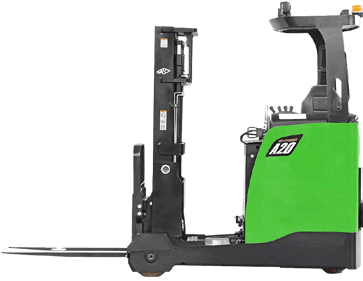
The principle of a reach truck is right there in its name: the mast, or the carriage holding the forks, reaches forward to pick the pallet from the racking, then retracts to bring it back within the machine's footprint before traveling. While the truck moves, the load stays inside the body of the machine, rather than cantilevered out front as on a counterbalance forklift.
That geometry changes everything: because the truck does not have to carry an offset load ahead of it while driving, it can work in much narrower aisles. Where a counterbalance forklift needs a wide aisle to turn and deposit, the reach truck makes do with a tight corridor.
Storage density
Narrower aisles translate directly into square metres handed back to storage. Every bit of aisle width saved is space you can reassign to extra racking. On the same slab, you fit more bays and more pallet positions, without moving a single wall.
The arithmetic is simple to state: less space given to circulation, more space given to stock. For a warehouse running out of room, switching to narrow aisles served by a reach truck is often the more rational alternative to a building extension, at a cost and lead time on an entirely different scale.
Height
The reach truck does not only shine on width, but on height too. It serves high-bay racking well above the lift heights of a standard counterbalance forklift, which lets you stack pallets across more levels and use the building's volume, not just its floor area. At heights where the operator can no longer clearly make out the pallet and the rack opening, stacking aids step in: a camera at the top of the mast feeding an in-cab screen, a height indicator, level pre-selection. Storing high in narrow aisles becomes both precise and safe.
Electric and designed for indoors
The reach truck is electric by design, which makes it an indoor machine through and through: zero emissions suited to an enclosed space, quiet operation, and non-marking tires that protect a warehouse slab. The cab is laid out for visibility, both upward and toward the load, an essential condition for precise stacking at height. Quiet, clean, and compact, it fits into a working warehouse without disrupting it.
When to prefer it over a counterbalance forklift
The reach truck excels in its domain, but it has its limits. It is built for indoors, on flat, smooth floors, with pallet-sized loads: it is not a machine for the yard, rough ground, or oversized loads. For outdoor work, ramps, uneven surfaces, or very heavy loads, the counterbalance forklift remains the reference.
| Criterion | Reach truck | Counterbalance forklift | | --- | --- | --- | | Aisle width | Narrow aisles | Wide aisles | | Stacking height | High bays | Standard height | | Environment | Indoors, flat floor | Indoors and outdoors, mixed ground |
The right instinct is to split the roles: the reach truck to densify and stack high indoors, the counterbalance forklift for heavy loads, outdoors, and difficult ground. Many warehouses combine the two by zone.
Explore our reach trucks and order pickers or request a quote.