For a fleet of electric trucks, the battery technology you choose commits you for several years of operation. Lead-acid and lithium-ion both meet material-handling needs, but on very different terms when it comes to charging, maintenance, organization, and cost. The sticker price tells only part of the story: it is real-world use, in single or multiple shifts, that should drive the decision. This guide compares the two technologies on the criteria that matter and gives concrete pointers to settle the choice. For day-to-day care, see also our dedicated article on battery life.
Lead-acid: proven but demanding
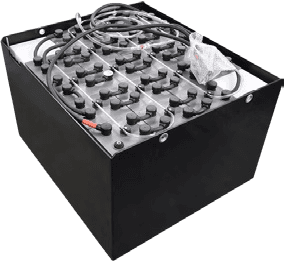
The lead-acid battery is still the most widespread option, and the cheapest to buy. Robust and well understood by operators, it has proven itself over decades of material-handling use. The trade-off is regular maintenance and strict charging discipline.
- Watering. Cells must be topped up periodically, or the battery degrades.
- Equalizing. Equalizing cycles are needed to balance the cells and preserve capacity.
- Ventilated charging room. Charging releases gases and requires a dedicated, ventilated, compliant room.
- Cooling time. After charging, the battery must cool before reuse, which sidelines the truck.
- Full charges. Repeated partial charges damage the battery; you have to aim for full cycles.
Run well, a lead-acid battery offers an excellent cost-to-performance ratio for a single-shift operation with overnight charging time available.
Lithium-ion: pricier, more flexible
The lithium-ion battery costs more to buy, but it changes how you work. It accepts opportunity charging: you plug the truck in during breaks, with no mandatory full cycle and no premature degradation.
- No watering. No cell maintenance, so fewer tasks and fewer things to forget.
- No dedicated room. Charging can happen in the work area, with no specific ventilated room.
- Longer cycle life. The number of supported cycles is generally higher than with lead-acid.
- Stable voltage. Power stays constant to the end of discharge, which preserves truck performance.
- Less maintenance. Fewer interventions on the battery over its whole life.
That flexibility comes at a higher purchase price, which has to be weighed against the uptime gained and the maintenance saved.
The multi-shift question
It is often the work organization that decides between the two technologies. In a single shift, the night is enough to recharge a lead-acid battery: the constraint is limited. Across two or three shifts, the truck has to keep running without a long charging pause.
With lead-acid, that usually means a spare battery and a physical changeover between shifts, hence a room, a storage area, and dedicated handling. With lithium, opportunity charging during breaks often lets a single battery last the day with no changeover. For intensive operations, this point weighs heavily in the calculation.
Thinking in total cost
Comparing the two technologies on purchase price alone leads to poor decisions. The right benchmark is total cost over the battery's life: purchase price, but also energy, maintenance, the charging room and equipment, any spare batteries, and truck downtime. A battery that is cheaper to buy but requires a room, regular watering, and a backup unit can cost more than a lithium solution over several years. Conversely, for light single-shift use, lead-acid often remains the most economical.
Choosing for your operation
| Criterion | Lithium-ion | Lead-acid | | --- | --- | --- | | Purchase price | Higher | Lower | | Charging | Opportunity, during breaks | Full cycle, cooling time | | Maintenance | Reduced, no watering | Watering, equalizing | | Cycle life | Generally longer | Shorter | | Best fit | Multi-shift, limited space | Single shift, overnight charging |
In practice: for a single-shift operation, with overnight charging time and room for a charging area, lead-acid remains a solid and economical choice. For intensive use across two or three shifts, constrained space, or a drive for maximum uptime, lithium-ion wins out despite its purchase price. For the detail of day-to-day care, see our guide on maintaining material-handling batteries.