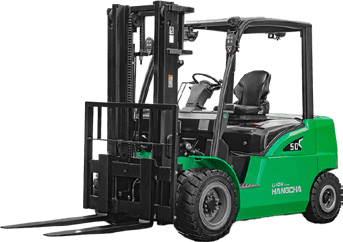
Few equipment decisions divide logistics managers like this one. Buy the forklift and own an asset, or rent it and keep your cash free? The honest answer is that it depends, but it depends on things you can actually measure: total cost of ownership, the hours the truck will really work, and what your cash flow can absorb. This guide walks through each factor and closes with a checklist you can run against your own operation.
The True Cost of Owning a Forklift
The sticker price is only the opening chapter of what a forklift really costs. Over a typical service life of 8 to 12 years, total cost of ownership (TCO) builds up across several lines:
- the purchase price, or financing costs if the machine is bought on credit;
- planned maintenance: oil changes, filters, scheduled inspections;
- repairs and wear parts: forks, tires, mast chains, hydraulic hoses;
- the traction battery on electric models, a major expense when replacement time comes;
- energy: diesel, LPG, or electricity;
- insurance and statutory safety inspections;
- operator training and certification;
- depreciation, meaning the gap between what you pay and what you resell for.
Depending on utilization, those lines combined often add up to more than the original purchase price over the machine's life. And there is a quieter cost: downtime. A forklift that breaks down with no backup means a loading dock at a standstill and trucks idling in the yard. If you run a single machine with no fallback, that risk belongs in the math.
When Renting Is the Right Call
Renting is the natural answer whenever the need is variable, uncertain, or temporary. A few classic situations:
- Seasonal peaks. A harvest campaign, a distribution warehouse's high season, year-end destocking: renting two trucks for three months beats owning two trucks all year.
- Fixed-term contracts. A 6 or 12 month project does not justify an investment designed around a 10 year life.
- A new operation. Until volumes settle, a monthly rent keeps you from locking capital into the wrong capacity.
- A replacement machine. Short-term rental keeps goods moving while your own truck is in for a major repair.
The market generally offers three plan lengths: short term (a few days to a few weeks), medium term (a few months), and long term (12 to 60 months). Long-term plans usually bundle full maintenance into the rent, so you know your cost per month with no surprises. On the finance side, rent is a deductible operating expense and the machine stays off your balance sheet; for an SME watching its borrowing capacity, that matters.
Renting has one more underrated benefit: it lets you test. A model, a lifting capacity, a power source (electric versus diesel) can all be proven in your own aisles, with your own loads, before any purchase.
When Buying Pays Off
Buying makes sense when utilization is heavy, stable, and here to stay. The logic is simple: rent is the price of flexibility. If you do not need flexibility, you are paying for nothing.
Three signals tell you it is time to buy:
- Utilization hours. When the truck works every day, or runs two shifts, cumulative rent eventually overtakes the full cost of owning the same machine over the same horizon.
- Stability. The need has existed for years and shows no sign of going away: same flows, same tonnage, same warehouse layout.
- Horizon. You are planning 5 years out or more. Depreciation spreads the expense, and residual value trims the final bill.
Ownership does mean owning the maintenance problem too. You have two options: an in-house workshop with a trained mechanic, realistic only for sizable fleets, or a service contract with a professional, which protects uptime without adding headcount. Buying a forklift without a maintenance plan is buying it twice.
One calculation worth doing before you sign anything: compare cumulative rent over your horizon (say, 60 months) against the full cost of ownership over the same period, net of resale value. The answer usually settles the debate on its own.
The Middle Ground: Inspected Used Equipment
Between new and rented sits a serious compromise: a reconditioned used forklift, priced well below new, with several years of service left in it.
The operative word is "inspected". A used forklift bought sight unseen is a lottery ticket. Before signing, insist on:
- the hour-meter reading, and whether it squares with the machine's overall condition;
- the full maintenance history;
- a check of the mast, chains, forks, and hydraulic system;
- on electric models, a battery test: a replacement can represent a large share of the machine's price;
- a written warranty, even a short one.
Buying from a professional who inspects and warrants used machines costs more than a private sale, but the premium vanishes with the first breakdown you avoid.
In short:
| Criterion | Rental | New purchase | Inspected used | | --- | --- | --- | --- | | Upfront capital | Low | High | Medium | | Monthly cost | Fixed rent, maintenance often included | Varies with repairs | Varies, warranty at the start | | Flexibility | Maximum | Low | Low | | Best fit | Variable needs, short horizons | Intensive use, 5+ years | Moderate use, tight budget |
A 7-Question Decision Checklist
Before you commit either way, answer these seven questions honestly:
- How many hours per year will the machine actually work?
- Is the need stable over 3-5 years, or tied to one contract, one season, one peak?
- What would tying up that much capital do to your cash flow and your other investment plans?
- Who will handle maintenance, and how fast can they respond when the truck goes down?
- Do you have a backup if the machine is out of service for a week?
- Is the spec right (capacity, lift height, power source, aisle width), or should you validate it through a rental first?
- What will the resale value look like at the end of your planning horizon?
If your answers lean toward uncertainty, renting protects you. If they describe an intensive, stable, well-financed need, buying, whether new or inspected used, is the rational choice.
Need help deciding? Request a free needs assessment.