Between the pallet truck, which moves pallets along the floor, and the forklift, which stacks them high with real versatility, the stacker fills a very useful middle ground. It lifts and stores pallets across a few racking levels, in a small footprint and at a reasonable cost. Two main families share this segment: the semi-electric stacker and the fully electric stacker. The right choice does not come from an abstract budget but from your actual operation: lift height, cycle frequency, travel distances, load weight. Here is how to decide without overspending or undersizing.
The stacker, between pallet truck and forklift
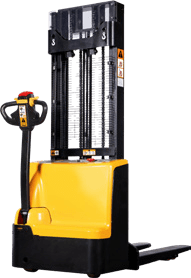
A stacker raises a pallet to place it on racking, across one or several levels. Unlike a pallet truck, which is limited to horizontal transfer, it stacks vertically; unlike a forklift, it stays compact, light, and designed for indoor use. That middle position makes it the ideal tool for stockrooms, small warehouses, back-of-shop storage, and workshops that need to store high without buying a full forklift or living with its bulk.
The semi-electric stacker
The semi-electric stacker combines a powered lift with manual traction: the operator pushes and pulls the machine by hand, while a motor handles raising the load. This compromise offers several advantages:
- Lower purchase cost than the fully electric, for an identical stacking function.
- Simplicity: fewer powered components, so less maintenance and an immediate learning curve.
- Compact and light, which eases maneuvering in tight spaces.
It suits occasional stacking over short distances perfectly: storing a few pallets in the back, feeding a workstation, breaking down a delivery. Its limit shows as soon as the trips grow longer or repeat: pushing a load by hand several times an hour, over tens of metres, quickly becomes tiring and slows the operation.
The fully electric stacker
The fully electric stacker powers both the lift and the travel. The operator drives the traction, with no physical effort to move forward or back. That gain changes everything as soon as the workload intensifies:
- Less fatigue for the operator, so a steady pace held all day.
- Longer trips handled effortlessly, between dock and storage area for example.
- Higher throughput: more stacking cycles per hour, with no drop-off late in the shift.
In return, it costs more to buy, weighs more, and carries a battery that must be charged and maintained. It is the justified investment once stacking becomes a job in its own right, repeated and timed.
The deciding factors
Rather than comparing the two machines in theory, measure them against your real operation. Five parameters almost always settle the decision:
- Lift height: how many racking levels, and how high the top one sits.
- Cycle frequency: a few pallets a day, or a continuous flow hour after hour.
- Distance: stacking on the spot, or regular transfers between two distant zones.
- Load weight: light, uniform pallets, or heavy and varied loads.
- Floor and aisles: available width, slab condition, ramps or thresholds.
Budget sits alongside these, but it should be weighed over time: a properly sized fully electric model avoids the fatigue, stoppages, and under-performance of a semi-electric pushed beyond its purpose.
| Criterion | Semi-electric | Fully electric | | --- | --- | --- | | Purchase cost | Lower | Higher | | Operator effort | Manual traction | Powered traction | | Throughput | Occasional, short distances | Sustained, long distances | | Best use | Occasional stacking in the back | Regular flow in a warehouse |
Battery, charging, and footprint
Both families carry a battery for the lift, the fully electric drawing on it more because of the powered traction. Plan a suitable charging point and charging habits consistent with the battery technology. On footprint, check the aisle width needed to turn, the clearance under the ceiling, and the allowable load on the floor. A stacker stays compact, but a fully electric model, being heavier, needs a sound slab and adequate aisles to deliver its throughput.
The right call fits in one sentence: semi-electric to stack now and then, on the spot and on a small budget; fully electric as soon as stacking becomes frequent, over real distances, with throughput to hold.